Studio Hand: A Refined Signature Script Font for Branding
I opened a new Illustrator file, the canvas stark and blank, tasked with a visual refresh for a local ceramics studio. The brief was clear: elevate their handmade charm into something elegant and marketable. My usual sans-serif roster felt too sterile. I needed a font with personality—a signature. That’s when I remembered a download I’d saved a while back: Studio Hand.
Studio Hand’s Personality for Logo Design and Signature Marks
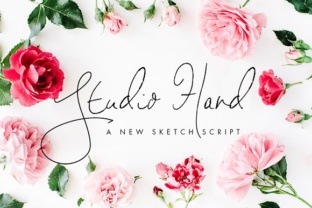
Studio Hand is a beautiful, signature styled script font, and that first impression is crucial. Dropping it onto a simple logo concept for “Clay & Craft” immediately changed the mood. The characters flow with a confident, refined elegance, avoiding the overly casual or frantic energy of some handwritten fonts. The uppercase letters have a distinct, artful flourish, while the lowercase maintains a clean, legible baseline. This isn’t a scribble; it’s a deliberate, stylish signature. For a logo, especially for creative businesses, artisan brands, or boutique shops, Studio Hand provides that instant mark of personal craftsmanship. It’s a font that feels authored, not just typed.
Testing Studio Hand on Packaging Mockups and Product Labels
Moving from the logo to a packaging mockup is where a script font like Studio Hand truly proves its worth. On a hypothetical ceramic mug label, the font’s graceful curves complemented the organic shapes of the product. In Script Handwritten fonts, readability at moderate sizes is key, and Studio Hand held up beautifully on a 3-inch tag mockup. The natural variation in stroke weight gives it a tactile, almost ink-on-paper feel, perfect for evoking quality and care in physical products. Whether for a skincare brand’s minimalist bottle or a bakery’s waxed paper bag, this font adds a ton of style without overwhelming the design. It’s ideal for short, impactful product names or descriptive phrases.
Building a Cohesive Brand Board with Studio Hand
A font is only as good as its ability to create system-wide consistency. On a brand board for the ceramics project, I placed Studio Hand as the primary display typeface. Its role was clear: headlines, the logo lockup, and accent text. For body copy and supporting information, I paired it with a simple, geometric sans-serif. This pairing strategy is vital. Studio Hand’s expressive nature needs a neutral counterpart to ensure readability in longer texts, like website paragraphs or brochure details. The contrast between its handwritten elegance and a clean sans-serif creates a dynamic, professional hierarchy. This font isn’t meant for body text; it’s a star player for display purposes.
Studio Hand for Website Headers and Social Media Graphics
The digital application is often the final test. Placing “Clay & Craft” in Studio Hand across a website header mockup instantly elevated the page. The font’s refined elegance translates seamlessly to screen, provided it’s used at a sizable display size. For social media layouts, particularly Instagram graphics promoting a new collection, Studio Hand became the go-to for the main caption overlay. Its personality cuts through the visual noise, granting a cohesive, branded look across posts. As a category of Fonts, handwritten scripts can sometimes struggle with webfont rendering, but assuming Studio Hand includes robust file formats and perhaps webfont availability, its performance in digital assets for creative studios or online shops would be strong.
When Studio Hand Might Not Be the Right Font Choice
Of course, no font is universally perfect. In my testing, Studio Hand’s limitations became apparent in contexts demanding high-density readability. It would be a poor choice for lengthy legal disclaimers on packaging, dense menu descriptions, or any small-point-size body text. Its strength is in impression, not information digestion. For formal corporate branding or highly technical industries, this script font would likely feel incongruous. It’s best reserved for projects where personality, artistry, and refined elegance are core brand values. Always test it in the actual context—print a business card mockup, view a website header on a phone—before finalizing client work.
Before committing any font to a permanent brand identity, checking its commercial licensing is a non-negotiable step. For a font like Studio Hand, which is so ideal for use in a ton of different project types—from logo design to product merchandise—ensuring the license covers client work, potential packaging, and web embedding is crucial. This practical safeguard lets you utilize the font’s style and refined elegance across all commercial assets with confidence.
Ultimately, my experiment with Studio Hand on that ceramics brand board confirmed its niche. It’s a font that doesn’t shout; it whispers with style. It brings a human, authored quality to digital and physical designs, making it a compelling tool for designers crafting identities for brands that value craftsmanship and elegance. If your next project calls for a signature touch, Studio Hand is a font worth testing on your own blank canvas.